
Data Quality & MDM
Data quality is managed over time.
A technically flawless warehouse is useless if the business distrusts the numbers. beVault allows you to declare controls on historized and multi-system data, report anomalies in actionable lists, and improve quality through corrections made in source systems.
In the platform
Declared controls, not improvised ones
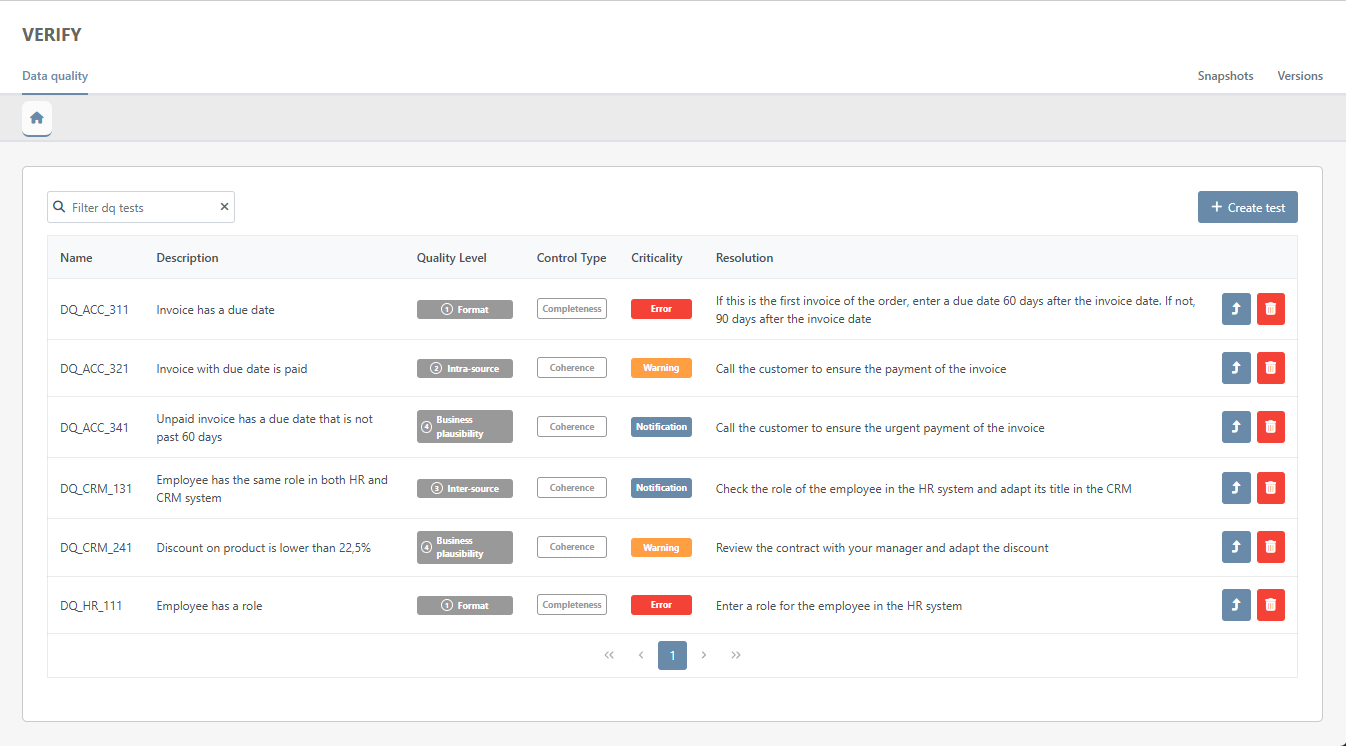
The problem
Detect anomalies before they propagate
Quality issues most often surface downstream: a report is published, an indicator circulates, and the discrepancy only appears afterward. By then, the decision has already been made on the wrong figure.
Because controls focus on historical data gathered from multiple systems, anomalies are proactively detected and linked to a specific source, rather than a general suspicion about the warehouse.
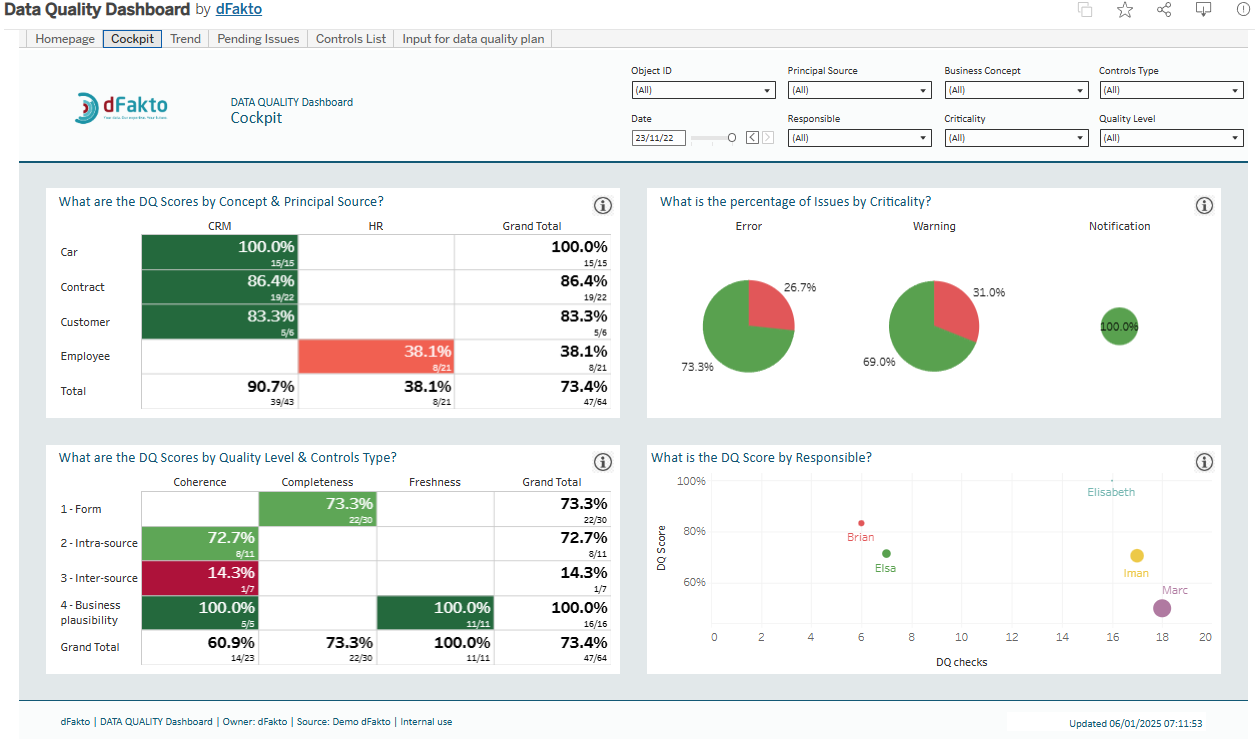
The quality loop
Detect errors. Fix them at the source. Sustainably improve quality.
Quality is not a one-time state: it is a repeating loop that progresses data over time.
- 01
Declare
Completeness, uniqueness, format, value ranges, referential integrity, inter-source consistency, specific business rules: rules are declared once and applied at each load.
- 02
Measure
Controls run on historized and multi-system data, at the source, domain, or load level.
- 03
Identify
Anomalies are reported in actionable lists, qualified and assigned to the relevant owner.
- 04
Fix in the source
Data stewards correct data in the source systems where the error was introduced.
- 05
Extract again
The corrected source is extracted again, without overwriting the history of what was received.
- 06
Test again
The same controls are replayed to verify that the correction produced the expected effect.
- 07
Deliver
Quality information is linked to the data concerned and its origin, so that the reliability of an indicator is visible when it is read.
- 08
Continuously improve
Measures kept over time show a trend: quality is managed as an indicator, not an incident.
Master data
A customer stays the same customer
Whether it comes from the CRM, the ERP or the billing system, a customer must be recognized as the same entity, without the original record disappearing. That's the role of Business Keys and historization in the model.
beVault provides a governed foundation for reference data and multi-source consistency: identity matching across systems, shared business keys, historization, traceability to the source, and consistent views of information. This foundation works alongside your existing reference-data processes; it does not automatically replace an MDM tool already in place.
Reference data management in practice- Operational governance
- Data owners, alert thresholds and decisions taken stay attached to the model rather than to a separate document.
- Existing tools
- beVault can consume your existing reference data as a source of truth when it's relevant for your organization.
What you get
A figure you can explain
Documented rules, historization and lineage: enough to reconstruct how a metric was produced, and from which data.
Frequently Asked Questions
Quality & MDM: Sensitive Points
Should non-compliant data be rejected?
Not necessarily. The Raw Vault keeps the data as it arrived: rules identify and flag issues without silently destroying the original history, and exceptions remain visible and tracked.
Can we keep our existing MDM tool?
Yes. beVault can work with your existing reference-data processes or MDM tool when it's relevant; it doesn't automatically replace them.
Who defines the rules?
Technical teams define technical controls, business teams contribute functional rules, according to the governance model actually in place in your organization.
How do you demonstrate compliance during an audit?
Data Lineage, history tracking and documented rules make it possible to reconstruct how a metric was produced at a given date. Compliance with a specific regulatory framework then depends on your own scope.
Next step