
Lineage & Documentation
A Data Lineage generated from what you build in beVault.
Data documentation almost always fails for the same reason: it is written alongside the system, then abandoned. In beVault, the model description is also what produces the processes: lineage is generated automatically for the elements built in the platform, while descriptions and additional metadata depend on the information provided by your teams.
Data Catalog
Retrieve, understand, explain
The catalog is the entry point for teams who need to work with data they didn't build themselves: find an entity, a table or a column, and immediately see which business domain it belongs to and where it's used.
Descriptions entered during modeling feed the documentation. It follows the model instead of drifting into a separate document, and goes all the way down to the column: definition, original source and role in the output consumed by BI or by an agent.
Where this metadata comes from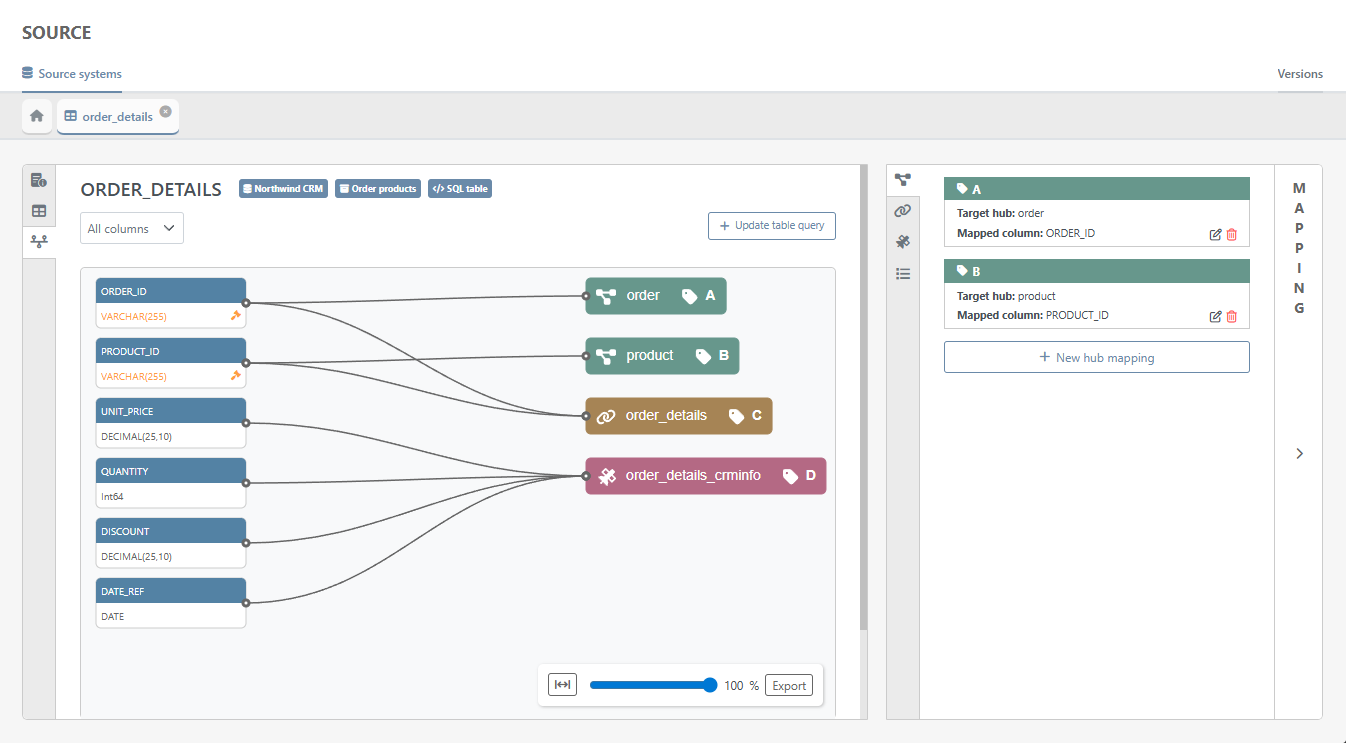
What this changes
Answer without rebuilding
“Where does this number come from?” becomes a query, not an investigation.
Data teams measure the impact of a change before making it, business teams check a definition without opening a ticket, and control functions handle audit requests based on the same metadata. Vocabulary becomes shared because it exists in only one place.
FAQ
Frequently asked questions
Do we need to manually document every column?
Some of the documentation comes from modeling metadata. Business definitions, however, remain a human decision: the platform collects and distributes them, it doesn't invent them.
Does lineage cover what happens outside beVault?
Lineage covers the processes driven by the platform. What is transformed downstream, in a BI tool for example, falls under that tool.
Does the catalog replace a governance program?
No. It removes the most thankless part — collecting and maintaining the information — but the rules, responsibilities and trade-offs still need to be defined with your teams.
Who uses the catalog day to day?
Data teams to understand the impact of a change, business teams to check a definition, and control functions to handle an audit request.
Next step