Integration & connectivity
Your data is already somewhere. The problem is bringing them together.
ERPs, business applications, files exchanged by email, legacy databases whose schema nobody remembers: integration is almost always the most costly step of a data project. beVault structures this step so it is repeatable, documented and owned by your teams.
In the platform
Map every source to the business model
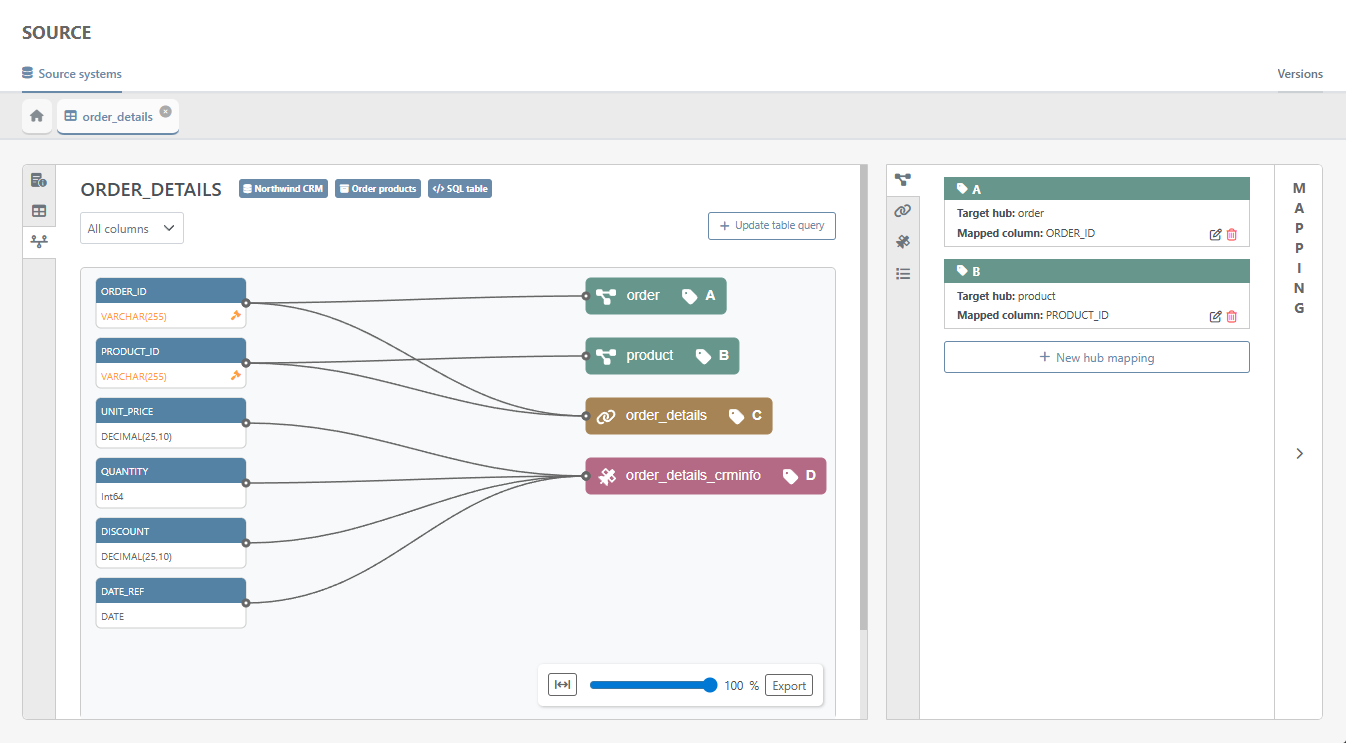
Source fields are mapped to the business concepts and attributes defined in beVault. Because the mapping is stored as metadata, it can be reviewed, versioned and propagated to the generated processes instead of being scattered across undocumented code.
The situation
An application landscape, not a single source
The systems that run your processes — operations, finance, HR, production — were never designed to be read together. Alongside them are old relational databases still in production, flat files dropped regularly, and a few APIs exposed by the most recent applications.
Each of these sources comes with its own frequency, quality and level of documentation. The challenge isn't connecting one: it's integrating them all into a common model, and keeping that setup understandable two years later.
The journey of a source
From connection to historized data
Every source follows the same path. This repeatability is what makes integration scalable instead of a project every time.
- 01
Connection
The source is declared and connected from your infrastructure. Access remains managed by your teams, according to your security rules.
- 02
Mapping
Source fields are linked to the entities and attributes described in metaVault. The mapping is metadata: readable, reviewed and versioned.
- 03
Ingestion
Extraction workflows retrieve data at the chosen frequency, fully or by delta, with execution tracking.
- 04
Historization
Changes are kept over time rather than overwritten. You can reconstruct the state of a piece of data at a given date and explain a discrepancy.
Targets
To your data platforms
Generated structures and loads apply to the target database you've chosen. beVault doesn't impose a platform on you: it produces code adapted to the one you already run.
Supported platforms, one by oneMultiple systems often feed the same business entities. Business Keys make it possible to reconcile them without losing the origin of each record — and the retained history is useful well beyond analytics: it de-risks migrations and application decommissioning.
Migration and retirement of legacy applications- Target platforms and databases
- Snowflake, Amazon Redshift, Microsoft SQL Server and PostgreSQL are supported today. Databricks, Microsoft Fabric and Google BigQuery are coming soon.
- Exposition
- Data retrieval via API when the source system exposes one, and exposure of prepared data through the beVault API.
What the integration covers
Heterogeneous environments, a single path
beVault is designed to integrate heterogeneous data environments: connection to sources, legacy ERPs and applications, multi-source, mappings, ingestion, historization and connection to target platforms.
How is the integration scope defined?
Implementation depends on available access, project scope, and target architecture. Scoping is done source by source with your teams.
Who manages access to the sources?
Your teams. beVault runs in your infrastructure and uses the access you grant, with your security and traceability rules.
What happens if a source changes structure?
Since mapping is metadata, changes are made at the description level and then propagated to the processes, rather than scattered across code.
Do you need to integrate everything at once?
No. Projects move forward domain by domain, which delivers value before the entire application landscape has been integrated.
Next step