
Data products & Information Marts
The Data Vault historizes. Marts make data usable.
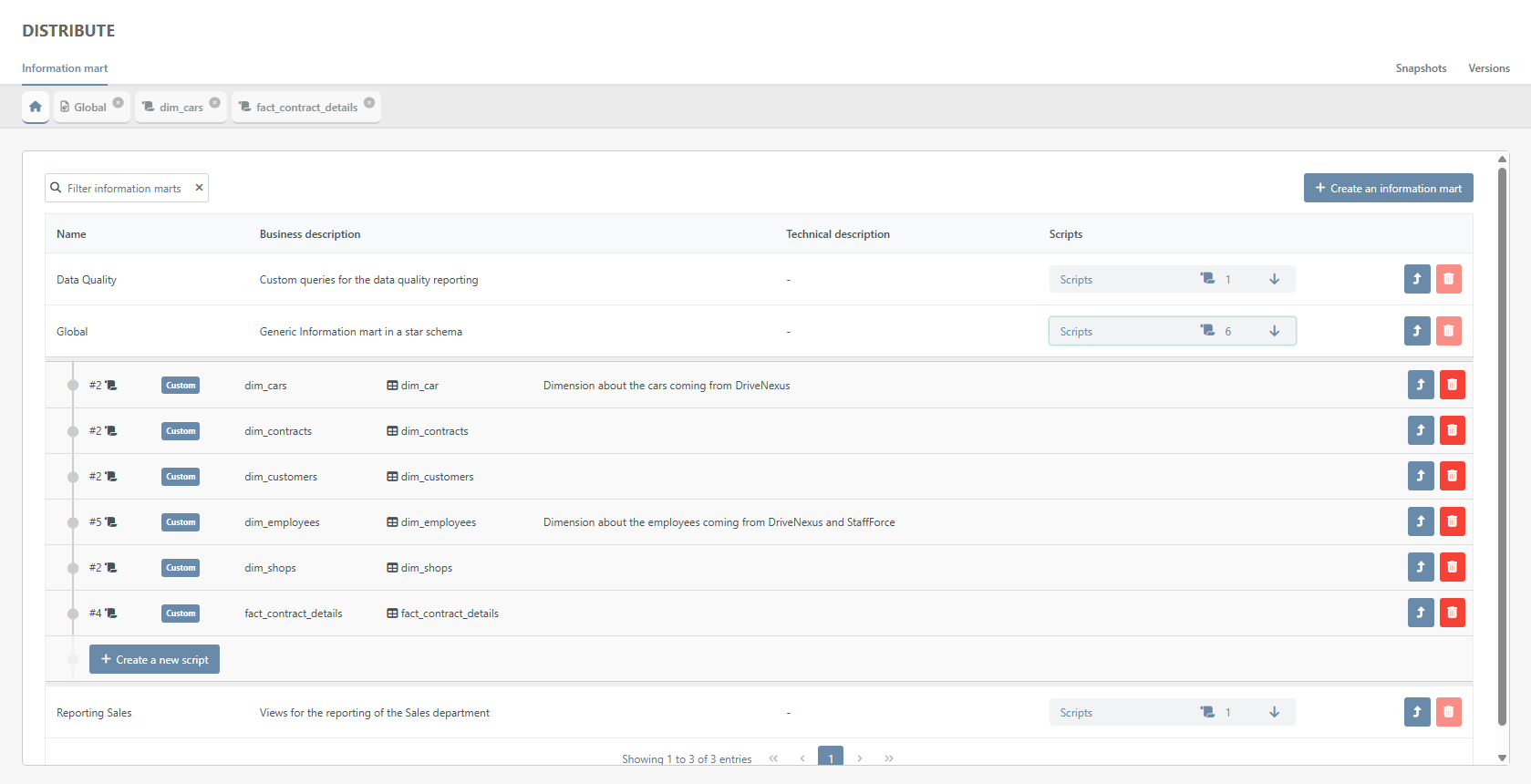
Nobody consumes hubs and satellites: users want a customer dimension, quarterly revenue, or a risk view at a given date. beVault builds these consumption layers on top of the Data Vault, as documented, usable data products.
In the platform
The datasets made available
The situation
When every team redoes its own calculations
Without a governed reporting layer, calculation logic gets rebuilt in every BI tool. Two reports then show two different figures, and no one knows which one is authoritative.
The problem isn't just technical: definitions become hard to trace, reporting logic becomes hard to maintain, and AI use cases end up without context or documentation on the data they consume.
Method
From business need to data product
- 01
Defining the indicator
The business defines the question it wants answered and the expected level of detail. The concepts already exist in the Data Vault: nothing to re-ingest.
- 02
Declare the mart
The data team assembles the consumption structures and associated business rules in beVault, documented in the same place as the model.
- 03
Generate and refresh
The mart is produced and then refreshed by the built-in orchestration, at the pace defined for that use case.
- 04
Publish to authorized consumers
The exposed layer is made available to the relevant roles and tools, according to configured permissions.
- 05
Preserve traceability
The path between sources and the exposed data remains available for review in the platform, within the scope covered by lineage.
Distribution
Produced in your target database
Information Marts are produced in the target database. They can be consumed by applications, BI tools, and AI agents within the scope configured for these consumers.
beVault does not replace your BI tool: it supplies that tool with governed, documented data. Your existing reports reconnect progressively, without a disruptive switchover.
API, MCP server and AI agents- Information Marts
- Available in the target database, in standard SQL, for Power BI, Tableau, Looker, SQL clients, and applications.
- API
- The API allows interaction with the platform and its metadata. It is not the channel through which Information Marts are made available.
- MCP Server
- The MCP Server allows certain configured interactions with the platform, within the defined scope.
What you get
A figure you can defend
A figure you can explain is worth more than a figure that's simply available.
Documented data products, metrics that are consistent from one team to another, calculations you can trace back to their origin, preserved source context, and a clean foundation for analytics and AI use cases.
Frequently asked questions
Consumption: what we're asked
Do we have to abandon our existing Power BI reports?
No. You gradually reconnect your reports to the governed marts; the presentation layer remains yours.
Are marts materialized or virtual?
Both approaches are possible depending on data volume, access frequency and the target environment. The choice is made when the mart is declared.
Can marts serve applications and AI agents, not just BI?
Yes. Information Marts are produced in the target database and can be consumed by applications, BI tools and AI agents within the scope configured for these consumers.
How do you handle conflicting business rules between departments?
The Data Vault separates raw data from interpretation rules. Each department can have its own mart, built on a shared, historized base of facts.
How do you trace a metric back to its sources?
The platform's lineage and documentation let you trace the path between sources and the exposed data, within the covered scope.
What happens when the source model changes?
Changes are handled in the model and in the relevant mart definitions, along with the associated documentation. The scale of the work depends on the nature of the change.
Next step