The Platform
A data foundation that your teams keep control of.
beVault builds on the Data Vault as its foundation, then automates what costs the most: producing and maintaining loading code, controlling quality, orchestrating workflows and publishing ready-to-use data — in the environment you have chosen.
The journey
One repeatable path from business model to usable data
beVault applies the same model-driven approach to every data project. Define the business meaning once, connect and historize your sources, verify the data, publish trusted outputs and orchestrate the flow. Each step builds on the same model and metadata, so your teams can deliver new use cases without starting over.
Build
Your architects describe business objects, their business keys, and their relationships. This description drives everything else.
Source
Source systems are connected and mapped to the model, then loaded while preserving the history of what was received.
Verify
Quality controls apply to historical data and report anomalies in actionable lists.
Distribute
Information Marts are produced in the target database, documented and ready to be consumed.
Orchestrate
The integrated orchestrator executes processes, manages dependencies, and provides visibility into every execution.
The starting point
Data Vault as the foundation
A data foundation has to absorb sources that change, business definitions that get refined, and questions not yet asked. That's what Data Vault solves: every load is historized, every business key is identified, nothing is overwritten.
The drawback is well known: hand-written, a Data Vault requires a lot of repetitive code and a discipline few teams sustain over time. beVault handles this mechanical part and leaves your teams the part that has value — business meaning.
Data Vault automation in detailmetaVault
The business model before the code
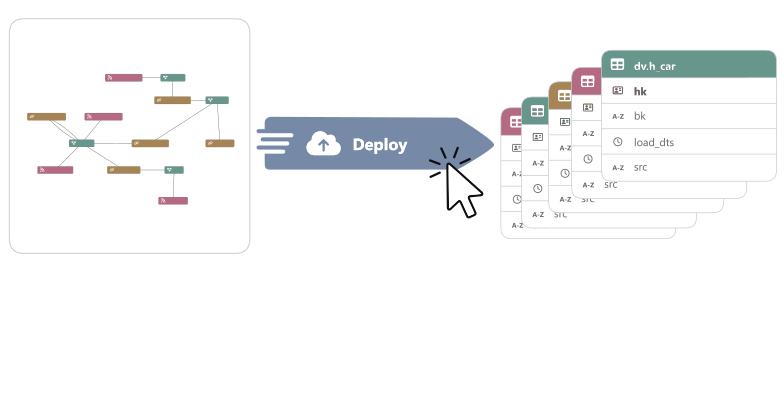
In metaVault, your architects describe what the organization actually works with: business keys, relationships, contexts, definitions. This model isn't a supporting document — it's the single source of truth the platform builds on.
See the metaVault modelingBecause the model is stored as metadata, the platform derives the structures, loading code, documentation and lineage from it. A change to the model propagates, instead of triggering a manual rework campaign across dozens of scripts.
Lineage and documentationIntegration
Preserve source history and context
Data is kept as received, without overwriting history. Each load keeps track of its origin and date, allowing the raw model to be reused for new needs and a source to be reconstructed as it was at a given time. You thus have a reliable basis for analysis, auditing, and compliance.
Integration and connectivityQuality and orchestration
Control during, not after
Quality rules live in the platform and apply at load time. Discrepancies are tracked, versioned and attributable to a source, rather than discovered a month later in a dashboard.
Data Quality and MDMOrchestration follows the model's dependencies: execution order, parallelism, error retries and supervision. AWS Step Functions is supported as an external orchestrator when you already use one.
OrchestrationInformation Marts
Data the business can actually use
A data foundation only creates value when people and systems can use it. beVault publishes governed information marts and documented business views for reporting, applications, APIs and AI agents. The same model can support both precise analytical queries and richer AI experiences.
Information MartsThese views are consumed with your usual tools — Power BI, Tableau, Looker or any SQL client — and by your applications via the API. The MCP Server also lets agents interact with the platform.
API and AI agentsTarget environment
The platform runs in your environment
beVault does not replace your stack: it generates native code for the target database you've already chosen, and runs wherever you decide.
- Target platforms and databases
- Snowflake, Amazon Redshift, Microsoft SQL Server and PostgreSQL are supported today. Databricks, Microsoft Fabric and Google BigQuery are coming soon.
- External orchestrator
- AWS Step Functions is supported as an external orchestrator. It is not a target database: it triggers and supervises processing.
- Deployment
- Docker is used as the deployment technology for components, on-premises, in the cloud, or hybrid, within the perimeter you control.
What this changes
Grow without rebuilding the foundation
With less hand-written loading code, consistent models and reusable information marts, each new use case becomes easier to deliver. The foundation grows with your organization instead of being replaced every time a source, business definition or AI tool changes.
Results depend on your starting point: number of sources, state of the existing model, team maturity. This is exactly what we look at together during a demo tailored to your context.
Next step